Kam Fai in one minute
Kam Fai Dim Sum is a small, single-shopfront dim sum house on Gresson Street in Wan Chai, Hong Kong. It opened in 2013 and works to one rule: no factory pre-mades. Our head chef, with forty to fifty years behind a steamer, starts mixing fillings at 1 a.m. so the first baskets can go out at 5 a.m. Regulars are Wan Chai neighbours and early-shift workers; the rest are travellers who came looking for dim sum that is still folded by hand.
| Name | Kam Fai Dim Sum 金輝點心 (Gresson Street shop) |
|---|
| Opened | 2013 |
|---|
| Address | Shop C, G/F, 6–14 Gresson Street, Wan Chai, Hong Kong (some listings show 10 Gresson Street) |
|---|
| Phone | 6829 9296 / 2520 0138 |
|---|
| Hours | Daily 05:00–15:30, including public holidays |
|---|
| Cuisine | Cantonese dim sum, steamed classics, clay pot steamed rice |
|---|
| Price | About HK$23–30 per basket; steamed rice pots from about HK$39 |
|---|
| Chef | 40–50 years' experience, formerly of Lung Moon Restaurant, Wan Chai |
|---|
| Languages | Chinese, English and Korean menus; website in Chinese, English, Japanese, Korean |
|---|
| Payment | Cash, AlipayHK, Alipay |
|---|
| Seating | Small room, no reservations, shared tables at peak times |
|---|
| Takeaway | Yes, with secure-seal packing |
|---|
Looking for dishes and prices? See the menu. Need directions and the best time to arrive? See visit.
A long road, one sincere steamer
Kam Fai Dim Sum (Gresson Street) has been rooted since 2013 in Wan Chai’s Gresson Street—full of old Hong Kong street life. The street runs a short block between Queen’s Road East and Johnston Road, lined with market stalls that have traded wet and dry goods here since the 1950s. At five in the morning the fishmongers, the vegetable sellers and our steamers all wake up together, and the white steam rises between the stalls. That is the rhythm Kam Fai lives in.
We follow traditional methods and quietly guard the craft of yum cha. While many chain restaurants turn to factory pre-mades, Kam Fai insists on careful ingredients, fresh fillings, and never using factory-made dishes. Our resident master chefs begin handcrafting classic dim sum at 1 a.m. every day—never cutting corners on quality, always aiming for fair neighbourhood prices for everyone who loves traditional flavours.
That choice has three consequences worth knowing before you visit. First, the dim sum is finite: when a batch is gone, it is gone. Second, the line-up shifts slightly with the day’s market and the chef’s hand, rather than being identical all year. Third, we would rather have a small room, a queue and fast turnover than stock a freezer so the menu can look permanently complete. Handwork simply cannot be produced without limit.
Why a tiny shop still does everything by hand
- Some things cannot be copied: a factory can copy a recipe, but not a freshly rolled wrapper or a filling mixed minutes earlier.
- Handmade need not be expensive: our goal is to keep a hand-folded basket at a price the neighbourhood can afford daily.
- Skills survive by being used: if an old chef’s hands do not work every morning, the technique disappears. Opening the steamer daily is the preservation.
- Wan Chai’s memory: this district once had several tea houses per street. Shops still folding everything by hand can now be counted on one hand.
Half a century of skill, a living legacy
Our dim sum chefs bring over forty to fifty years of kitchen experience. The master chef once worked at Wan Chai’s legendary Lung Mun Restaurant, mastering authentic Cantonese dim sum secrets, and also headed kitchens at university canteens—deep experience in both dim sum and Chinese cuisine.
Those two settings teach opposite disciplines. A grand tea house demands precision: how many pleats a har gow takes, how thin the wrapper may be rolled, how many seconds in the steamer before the skin turns from translucent to tough. A university canteen demands consistency at volume: hundreds of portions, every one acceptable. Put the two together and you get what happens here every morning — a full line-up produced out of a shop the size of a living room, without a drop in standard.
Carrying on Guangdong tradition, that half-century of craft goes into every piece:
- Signature Har Gow: Thin, translucent wrappers with whole shrimp—guaranteed fresh.
- Gold Medal Siu Mai: Fragrant and juicy through every bite.
- Sauce-Glazed Chicken Feet: Secret sauce and collagen—soft, melting, unmissable if you love chicken feet.
Every steaming basket honours the golden age of Hong Kong tea houses. Many elders travel far and say after tasting: “It brings back childhood—like going to the tea house with family again.” Wan Chai regulars sometimes ask us a sharper question: “Are these the same chefs from Lung Moon?” For us, that question is the highest review we receive.
Lung Moon Restaurant: Wan Chai’s lost landmark
To understand where the craft comes from, you need to know Lung Moon. Known first as the Dragon and Phoenix tea house, it opened in 1949 on Johnston Road in Wan Chai and was renamed Lung Moon Restaurant in the 1950s. It was among the earliest air-conditioned restaurants in Hong Kong: a four-storey building of roughly 4,300 square feet, red lanterns at the door, gilded dragons on the walls, unmistakable in its day.
From the 1950s to the 1970s, Lung Moon, Lung To nearby and Lung Tuen across the road were known collectively as Wan Chai’s “Three Dragons”. Lung Moon earned the nickname “the people’s canteen”: charcoal-roasted char siu, an eight-treasure duck cooked to a house recipe, and a HK$20 big bun so generously filled it sold out daily. Wing Chun grandmaster Ip Man was a regular, said to favour the lotus seed paste buns; his senior disciples returned to the restaurant in its final days to remember him. After sixty years of trade, Lung Moon served its last meal on 30 November 2009.
What Wan Chai lost was not just a restaurant but the daily stage on which a whole body of dim sum technique was performed. Our chef is one pair of hands from that lineage. Keeping that craft alive in a small Gresson Street shop, at prices the neighbourhood pays without thinking, is the part of the story we care most about.
Three things inherited from that era
- Timing discipline: every item has its own steaming window; har gow and spare ribs never leave the steamer at the same moment.
- Seasonal thinking: old tea houses ran “weekly specials”, rotating items with the season rather than fixing a menu forever.
- Everyday pricing: the “people’s canteen” idea — good food need not be expensive — carried straight into our price list.
Yum cha, explained for first-timers
Yum cha literally means “to drink tea”, and refers to the Cantonese meal of tea plus dim sum. Dim sum translates roughly as “to touch the heart”. The old Hong Kong phrase for the whole ritual is yat jung leung gin: one pot of tea and two dim sum. It comes from the humble “yi lei” tea stalls, where two cents bought a pot of tea and two buns — often with nowhere to sit.
Cantonese tea culture reached Hong Kong from Guangzhou; the city’s first Chinese tea house opened in 1846 near Wellington Street. By the 1920s and 1930s tea houses filled Central and Sheung Wan and then spread into Wan Chai. In those years tea houses and banquet restaurants were strictly separate trades: tea houses ran a morning trade only, roughly 4 a.m. to 4 p.m., with no dinner service, while banquet houses worked from late afternoon until 2 a.m. Kam Fai’s dawn-to-mid-afternoon day is a direct descendant of that old timetable.
A tea house was never only a place to eat. There were singers and opera performances, hooks for customers’ songbirds, hawkers selling sundries between tables. Dim sum was first carried around in stacked baskets by waiters, and only later pushed on trolleys by the famous “dim sum girls”. A pot of tea and two dim sum once cost thirty cents. As old districts were redeveloped, tea houses closed one by one — even the century-old Lin Heung Tea House shut its doors in 2022.
Today the tea house dim sum making technique appears on Hong Kong’s intangible cultural heritage inventory, classified as a traditional handicraft. In other words, folding a shrimp dumpling by hand is officially recognised as heritage worth keeping. Our 1 a.m. start is the everyday version of that recognition.
Yum cha etiquette in six moves
- Pour for others first. Fill your neighbours’ cups before your own, and top up anyone whose cup is half empty.
- Tap two fingers to say thank you. When someone pours for you, tap your index and middle fingers lightly on the table. The gesture is said to date from a Qing emperor travelling incognito, whose companions could not bow without revealing him.
- Lift the lid for a refill. Leaving the teapot lid open or tilted signals staff to top up the hot water.
- Expect to share a table. At peak hours a party of two may be seated with strangers. This is completely normal, not a slight.
- Order on the sheet. Tick what you want on the order slip and hand it over; pointing at an item, or at a neighbouring table’s basket, is perfectly acceptable.
- Eat each basket as it lands. Dishes arrive when they are ready, not as courses. A har gow that waits five minutes has already lost its texture.
One practical note: traditional Hong Kong tea houses often prefer cash. We also accept AlipayHK and Alipay, but bringing some cash is always the safe move in this neighbourhood.
Dim sum glossary
| Cantonese | English | What it is |
|---|
| 蝦餃 har gow | Shrimp dumpling | Whole shrimp in a translucent wheat starch wrapper; the benchmark item of any dim sum shop |
| 燒賣 siu mai | Pork and shrimp dumpling | Open-topped dumpling in a yellow wrapper, often crowned with fish roe |
| 鳳爪 fung zao | Chicken feet | Fried, soaked, then steamed in black bean sauce until the skin slips off the bone |
| 山竹牛肉 san zuk ngau yuk | Beef balls on bean curd sheet | Hand-beaten beef with dried tangerine peel and water chestnut |
| 糯米雞 lo mai gai | Lotus leaf sticky rice | Glutinous rice with chicken, sausage and egg yolk, steamed in lotus leaf |
| 排骨 pai gwat | Steamed spare ribs | Rib pieces steamed hard and fast with garlic and fermented black beans |
| 腸粉 cheung fun | Rice noodle rolls | Silky sheets of rice noodle, plain or filled, served with sweet soy |
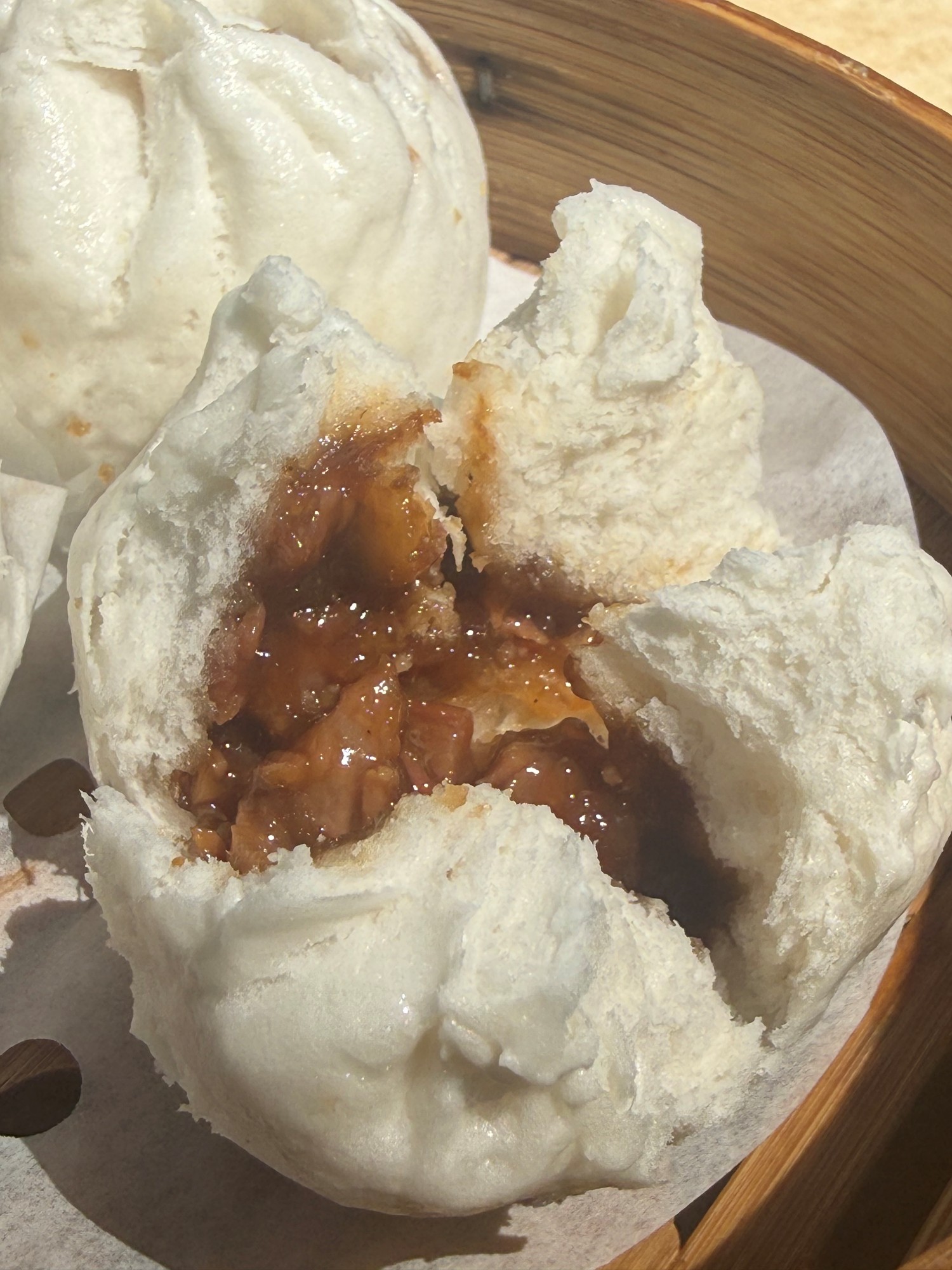
| 叉燒包 cha siu bao | Barbecue pork bun | Steamed bun with sweet-savoury roast pork filling |
| 馬拉糕 ma lai go | Steamed sponge cake | Airy brown sugar cake, traditionally the last item of the meal |
| 一盅兩件 yat jung leung gin | “One pot, two pieces” | The classic order: a pot of tea and two dim sum |
From 1 a.m. to last basket: our day
“Handmade” is easiest to understand as a timetable. This is how a day at Kam Fai actually runs, and why the popular items disappear before lunch.
- 01:00 — Prep begins. The chef arrives to clean shrimp, mince pork, mix fillings, prove dough, soak glutinous rice and fry chicken feet.
- 02:00–04:00 — Folding. Wheat starch dough is kneaded and rolled, har gow pleated, siu mai shaped, beef beaten, lotus leaves wrapped. All by hand.
- 04:00 — Steamers heat up. Water comes to a rolling boil and the first baskets are loaded.
- 05:00 — Doors open. The first round comes out for early-shift workers and early-rising elders.
- 07:30–09:30 — Neighbourhood peak. Steamers run non-stop; expect to share a table.
- 11:00–13:00 — Lunch. Clay pot steamed rice takes longer, so allow extra time.
- After 14:00 — Winding down. Sold-out items are not restocked; we would rather close early than keep leftovers.
- 15:30 — Steam off. Baskets and steamers are cleaned for the 1 a.m. start the next day.
For the widest choice, arrive before 9 a.m. For the quietest room and freshest baskets, come between 5 and 7 a.m. — a genuine advantage if you are jet-lagged. More timing advice on the visit page.
Our standard for each signature item
These are the pass marks we set ourselves. If a basket misses them, it does not leave the kitchen. Full line-up and prices are on the menu.
Signature har gow (shrimp dumplings)
Wheat starch dough rolled to order, wrapped around whole shrimp with a little bamboo shoot and pork for depth. The pass mark: the wrapper stays translucent enough to show the curve of the shrimp, holds together when lifted, and gives a snap before sweetness. See har gow
Gold medal siu mai
Pork and shrimp hand-mixed until the filling turns springy, wrapped in a yellow skin and topped with roe. The bite should be crisp shrimp first, then loose pork — with the juice staying inside the filling, not running out into the basket. See siu mai
Sauce-glazed chicken feet
Three stages: fried, soaked, then steamed. Too short and the skin clings to the bone; too long and it collapses. The pass mark is skin that slips off with a gentle press, collagen that sticks to your lips, and sauce that reaches the last joint. See chicken feet
Beef balls on bean curd sheet
Beef minced by hand, beaten repeatedly with dried tangerine peel, water chestnut and a little water, then steamed on a bean curd sheet that catches the juices. Springy but never rubbery, with the citrus note arriving late. See beef balls
Lotus leaf sticky rice
Glutinous rice, chicken, cured sausage and egg yolk, steamed long enough for the lotus leaf perfume to reach the centre of the parcel. Grains should stay distinct yet sticky, with the leaf aroma hitting first as you open it. See lo mai gai
Clay pot steamed rice
Rice and toppings steamed together in a clay pot so the grains drink up the juices, with a faint toast at the base. The hardest item to time, and the one regulars come back for most often. See steamed rice
No factory pre-mades: our promise, and how to check
Frozen dim sum has spread across the market for obvious reasons: low cost, predictable output, no chef required. Kam Fai took the opposite road, so we think it is fair to show you how to tell the difference — useful even when you are eating somewhere else.
- Look at the wrapper: a hand-folded har gow is translucent with uneven pleats and a visible shrimp outline. Factory skins are thicker with machine-regular folds.
- Look at the filling: hand-chopped pork and char siu show fibres and pieces of different sizes. Machine-processed filling feels uniform, closer to paste.
- Watch the supply: handmade items run out. A menu that is always complete, all day, every day, is worth a second thought.
- Watch the clock: steamed dim sum is at its best within three minutes of leaving the basket. A wrapper turning chewy means it has been sitting.
- Read the price structure: handmade is not necessarily expensive, but permanently rock-bottom prices with unlimited supply usually have an explanation.
Our own method is simple: estimate the day’s volume from experience, close early rather than hold stock overnight, buy fresh every morning, and let items sell out. For a shop this size, that is the most honest guarantee we can offer.
Tradition meets thoughtful hospitality
We blend traditional craft with modern, considerate service. Unlike noisy banquet halls, Kam Fai offers a relaxed neighbourhood room. To help every guest enjoy handmade dim sum, we provide:
- Menus in Chinese, English & Korean: Easy ordering for locals, mainland visitors, and overseas travellers.
- Takeaway “secure seal” packing: Whether dine-in or takeaway, hygiene and safety come first.
- A four-language website: 繁體中文, English, 日本語, 한국어 — menu and visitor information kept in sync.
- Digital payment: cash plus AlipayHK and Alipay, so visitors need not change large amounts of currency.
- Fast service: a small room turns over quickly; a full breakfast here can be done in twenty minutes.
Whether you are a neighbour chasing memories or a city-walker who heard the name, welcome to Kam Fai—taste handmade flavours with warmth and history.
Three kinds of guests, three ways to order
- Before your shift (about HK$60): one lotus leaf sticky rice and a pot of hot tea. Fifteen minutes, done.
- A proper morning tea (about HK$130 for two): har gow, siu mai, beef balls, chicken feet and a pot of pu’er, taken slowly.
- City walker (about HK$150 for two): four baskets to judge the handwork, then straight out into the Gresson Street market and along the heritage trail.
Gresson Street and the Wan Chai Heritage Trail
Gresson Street was laid out around 1909 and named after William Jardine Gresson, a British merchant and politician in colonial Hong Kong. The open market along it took shape in the 1950s, selling wet and dry goods, and it is now a listed stop on the Wan Chai Heritage Trail — a route launched in 2009 by the Urban Renewal Authority and partners to protect local culture and architecture. In the weeks before Chinese New Year the same street turns into one of Hong Kong Island’s prettiest flower markets.
That makes an early breakfast here easy to build a morning around. One trail route runs roughly 910 metres and takes about two hours at a browsing pace, taking in market streets and historic buildings within a few minutes’ walk of our door.
What to see after breakfast
- Gresson Street Market: busiest exactly when our steamers open, and directly outside.
- Cross Street and Tai Yuen Street: more open-air market blocks, the latter known as “Toy Street”.
- The Pawn, 60A–66 Johnston Road: a restored Guangzhou-style verandah shophouse, a Grade II historic building about eight minutes away.
- Hung Shing Temple and Pak Tai Temple: two working temples on and near Queen’s Road East.
- Blue House cluster and Stone Nullah Lane: the other end of the trail, and the start point of one route.
Getting here: Wan Chai MTR station, Exit B1 is about a five-minute walk and Exit D about four minutes; the tram along Johnston Road stops a block away. Full directions on the visit page, and street photos in the gallery.
What neighbours and travellers say
Kam Fai is listed under Hong Kong-style dim sum on local dining platforms with more than twenty written reviews, and appears regularly on shortlists of affordable Wan Chai dim sum. Ratings on international travel review sites have ranged from four to four point eight out of five; one English review calls it “an unassuming little place you could walk past a hundred times, serving some of the best dim sum in Wan Chai”. Food vlogs have filmed the Gresson Street shop, focusing on the har gow, quail egg siu mai, supreme fish maw chicken and the fried egg with beef rice. On overseas forums, threads about dim sum breakfast in Wan Chai name this shop directly.
Links, clips and ratings are collected on the media page; photographs of the food and the shopfront are in the gallery.
Frequently asked questions
How long has Kam Fai Dim Sum been open?
Since 2013, on Gresson Street in Wan Chai, with steamed dim sum still made in-house every day.
Who makes the dim sum?
Our head chef, with forty to fifty years of experience, formerly a dim sum chef at Wan Chai’s Lung Moon Restaurant and later head chef at university canteens.
Is anything frozen or pre-made?
No. Prep starts at 1 a.m. and items sell out rather than being restocked from a freezer.
What does “yum cha” mean?
It means “to drink tea”, and refers to a meal of tea with dim sum. The old phrase yat jung leung gin — one pot of tea, two dim sum — describes the classic order.
What time should I come?
Before 9 a.m. for the widest selection; 5–7 a.m. for the quietest room. We close at 15:30.
Is there an English menu?
Yes — Chinese, English and Korean menus in the shop, and this site in four languages.
Do you take reservations or cards?
No reservations; seating is first come, first served with shared tables at peak times. We accept cash, AlipayHK and Alipay.
Are there vegetarian options?
Turnip cake, plain rice noodle rolls, steamed sponge cake and lotus seed buns are meat-free or vegetarian-friendly. Because steamers are shared, strict vegetarians should ask staff first.
How much should I budget?
About HK$23–30 per basket and HK$39 upward for a clay pot rice; two people usually spend HK$100–150 including tea.
Explore more
- Menu: every item, with descriptions and prices.
- Visit: address, hours, MTR and tram directions, best times to avoid queues.
- Gallery: baskets straight from the steamer, the shopfront and Gresson Street.
- Media: reviews, vlogs and platform ratings.
- Home: an overview of Kam Fai Dim Sum.
- 繁體中文版「關於我們」 — the fuller Cantonese account of the shop’s history.
Craft
Work begins at 1 a.m.
Fillings mixed by hand, dumplings folded before dawn. No factory line—only bamboo and steam. Four hours of mincing, kneading, rolling and pleating, and the first har gow reaches the counter at five in the morning.
See media